




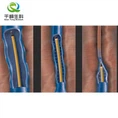
The first stage is the embryonic stage of microcatheter endovascular treatment technology, in the late 60s and early 70s of the 20th century, Professor Djindjian of France first pioneered the ultra-selective angiography and selective spinal angiography of the external carotid artery; The second stage (from the 80s of the 20th century to the beginning of the 21st century) is the emergence of early intervention microcatheters, and since the 80s, France and the United States have successively developed Magic microcatheters and Tracker microcatheters with gradually tapering front ends and can be bent arbitrarily, coupled with the advent of digital subtraction X-ray machines, making microcatheter technology more advanced [1]. The third phase (after 2005) is the booming period of coronary microcatheters, and guidewire flexibility, application and enhancement of microcatheters, and surgical strategy development have become the new development direction of CTO-PCI. In 2005, Professor Ge Junbo made a preliminary attempt on reverse interventional treatment CTO in the surgical broadcast of TCT. This case is a CTO lesion at the LM bifurcation with good collateral circulation from RCA to the left crown. The guidewire cannot pass through the lesion during forward intervention. Finally, the Runthrough guidewire is fed backwards from RCA into LCX, followed by successful completion of the Kissing wire of the front guide wire and the reverse guide wire. Relevant research data published at TCT in 2009 showed that the development of reverse technology greatly improved the success rate of CTO surgery.
At present, there are more and more microcatheter brands on the market, and the design of microcatheters is also emerging, but the overall performance shows the following trends:
1) Microcatheter tip conical design - improve the passage ability of the microcatheter tip end in stricture lesions.
2) Microcatheter head end preshaping / adjustable bending - to ensure good passage and tracking of microcatheter, while improving the control of microcatheter for the guidewire, making it easier for the guidewire to enter the target blood vessel.
3) The mixed density braided (proximal dense, distal thin) or braided composite spring structure of the microcatheter tube body is more popular, and more attention is paid to the rotation control of the microcatheter - while the microcatheter obtains good support, it ensures good flexural resistance, pushability and flexible tracking performance of the microcatheter as a whole.
4) Microcatheters are developing in a more refined and specialized direction, and the situation of a microcatheter fighting the world no longer exists - dealing with different types of lesions (such as tortuous and narrow lesions, CTO lesions) and applications (such as forward, reverse). In general, it is a trend in the future development of microcatheters to achieve excellent passage and handling of microcatheters by integrating design concepts such as conical tips, pre-shaped or adjustable elbow ends, and composite structure tubes.

Microcatheter technology can be roughly divided into three stages
May 16, 2023 Leave a message
Send Inquiry