

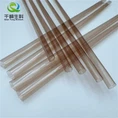


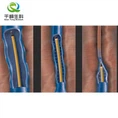
The design and manufacture of the tube body plays a key role in the performance of microcatheters, which usually contain an inner lining, an intermediate reinforcement layer, an outer polymer, a surface coating, etc. Among them, the lining material is usually selected as a lubricating material (such as PTFE) to ensure smooth lumen; The middle reinforcement layer usually uses metal wire weaving or winding to achieve the design method of increasing the strength of the catheter and pushing force, in many microcatheters, this weaving or winding method is roughly divided into: weaving, winding, weaving + winding (juxtaposition), braiding over winding (multi-layer) 4 kinds, the design of the middle reinforcement layer represents the need for important performance of microcatheters by different vascular lesions, such as the design of weaving + winding can make proximal weave good pushability, distal winding flexibility, which is for neurovascular delivery, It is a very good choice, and for CTO lesions, a high hardness weave can help it pass through calcification; The outer layer of polymer materials, also with clinical practical use, with a series of materials with different hardness, mechanical conduction from near and far, this idea of hardness gradation, in fact, coincides with the design of the middle layer; In addition, the distal surface of the tube body is usually coated with a certain length of coating material (usually hydrophilic) to improve the passage of microcatheters through blood vessels and lesions. It is this "sandwich" structural design of inner lining + middle layer + outer layer + surface coating that creates the excellent performance of microconduit "opening the road every mountain and building a bridge when encountering water".

The microcatheter is generally composed of a handle (seat), a strain relief sleeve, a tube body, a sign and other parts.
May 15, 2023 Leave a message
Send Inquiry